Writing / 19 February 2026
Sorting the Wheat from the Chaff
First published on Substack on 19 February 2026.
Now then, let’s be honest here, and I’ve spoken about this before……....
Been stalling on this for months. Folders full of PLR I bought with good intentions and barely touched. Reports, article packs, and email sequences, all sitting there, poking fun, guilting me every time I see them.
There’s likely a lot of rubbish. Some may be salvageable. I need to go through it.
So I’m on with what I should have done ages ago: sorting the wheat from the chaff. Working out which files are worth the effort to fix and which ones need hoofing out.
Here’s how I’m going to tackle it:
Hoarding PLR is a problem
Not only clutter, but the mental weight of knowing you’ve shelled out for stuff you’re not using. Every time I see those folders, I know I should be doing something with that.
After a while, I stop opening them because it’s easier to ignore it than to face how much is sitting there redundant.
That’s where I’m at now, knowing some of these files will be useful if I put in the work. But there’s also plenty of crap, too outdated, too poorly written, or just completely wrong for what I’m doing now.
I have to separate the two. Stop pretending I’ll magically use everything and face up to what’s worth keeping.
What I’m Looking For
When I go through my vault this week, I’m asking three questions about each file:
1. Is the core information still valid?
If a file is built around strategies that don’t work anymore or platforms that shut down years ago, it’s not worth my time. I’m not interested in salvaging content that would mislead people just because I paid for it.
Some PLR will age better than others. Evergreen topics like productivity, communication, and basic marketing principles all tend to hold up. Tactical stuff tied to specific tools or algorithms? You can bet that dates fast; we all know that.
2. Can AI fix what’s wrong with it?
Limp and lifeless writing, bland tone, paper-thin explanations, and problems that AI can sort quickly. If the meat of it is solid but is poorly executed, you can surely mend it.
But if the whole thing is a mish-mash: factually wrong, poorly structured, or just incoherent, then it’s probably going to be faster to start from scratch than trying to salvage it.
3. Does it fit what I’m actually doing?
I’ve bought PLR that looked useful at the time, but it’s not where my business is now. Health content when I was focused on marketing. Advanced tactics when I was still figuring out the basics.
Even if the content is good, if it doesn’t serve my audience or align with what I’m teaching, it’s chaff. No point keeping it just because it exists.
The AI Prompt I’m Testing
Instead of reading every file line by line, I’m using AI to flag what needs attention. Here’s the prompt I’ll be running on each piece:
“Review the following content and create a list of outdated elements: platforms that have changed or shut down, statistics more than 3 years old, tools that have been replaced, marketing strategies that no longer work, and references to obsolete technology. For each item, note whether it can be updated with current information or whether the entire section needs rethinking because the underlying strategy is no longer valid.”
This should give me a diagnostic rather than an automatic rewrite. I’ll know what’s fixable and what’s not before I waste time trying to salvage something that’s beyond repair.
Just as an aside, this prompt evolved from another I had saved from somewhere:
“Rate my above prompt on the scale of 10”.
Next, instruct ChatGPT to “Make it a 10 out of 10”.
I use it regularly and find it works really well. See here how it worked out.
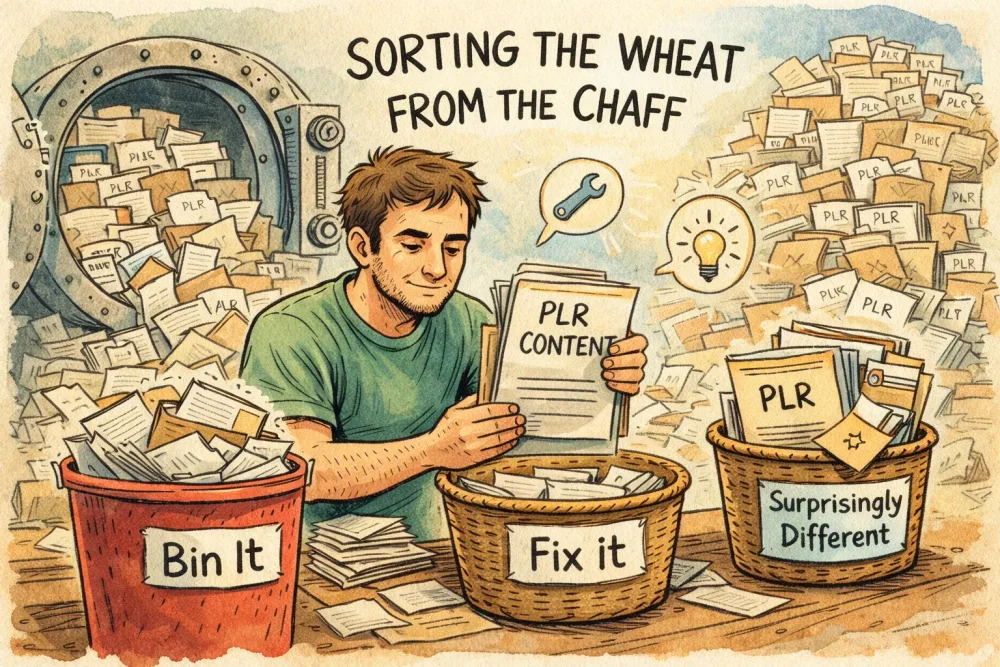
Three Piles
Eventually, everything will land in one of three categories:
Bin it: Content that’s too far gone. Wrong information, dead strategies, or just so poorly done that fixing it would take longer than creating something new.
Fix it: Solid foundation but needs work. The core concept is sound, but the execution needs updating, tightening, or voice adjustment.
Surprisingly decent: Files that are better than I thought. May need micro-tweaks but pretty much ready to use.
I reckon most will end up in the “Fix it” category. Might be a few pleasant surprises. No doubt a fair chunk will go straight in the bin.
Why Bother?
You might be thinking: if AI can write fresh content, why bother with old PLR at all?
Two reasons.
First, starting with a framework is faster than starting with nothing. Even weak PLR gives you structure and ideas to build on. You’re refining, not inventing from scratch.
Second, I’ve already paid for it. Might as well see if there’s anything worth using before I spend more money on new packs or waste time creating everything myself.
That said, I don’t know yet if this will be worthwhile. I might find a few hidden gems, or I might discover I’ve been hoarding mostly junk. Either way, I’ll know what I’m working with instead of just feeling guilty about it.
What’s Next
I’ll run this assessment over the next few days and come back with what I actually found. Real examples of what was worth keeping, what got deleted, and whether this approach made sense.
Sitting on your own pile of unused PLR? Maybe follow along and try sorting your own. Let’s compare notes and see if the process holds up.
Hit reply if you’ve already done something similar. I’d be curious to hear what you found and whether you regretted keeping anything you should have binned.
Want to follow along? Subscribe below for updates on The Extraction Method: Turn Existing Content Into a Paid Asset Using AI and what I’m learning. No guru promises. Just real progress as it happens.